
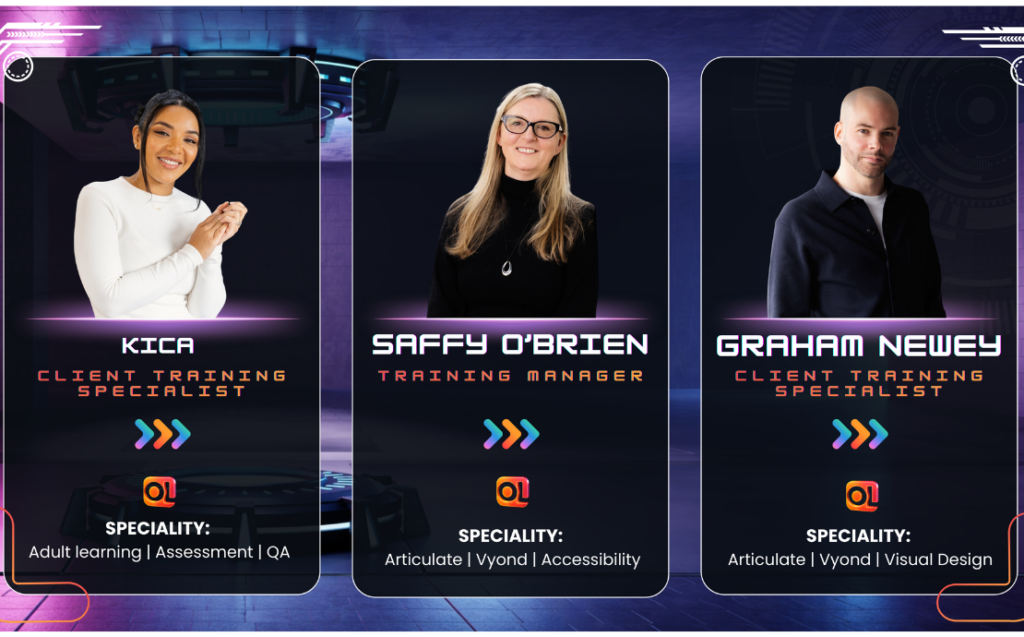
Every mission needs the right crew.
At OL, our trainers are the people in mission control – the ones who know the systems, understand their audience and know how to make learning stick. They each bring their own specialisms but share the same goal: to deliver training that makes an impact.
We sat down with three of them to explore how they work, the trends to watch and what great learning looks like in practice.
👉 More from OL: “I don’t need training” and other myths holding L&D back
Crew ID: Saffy O’Brien
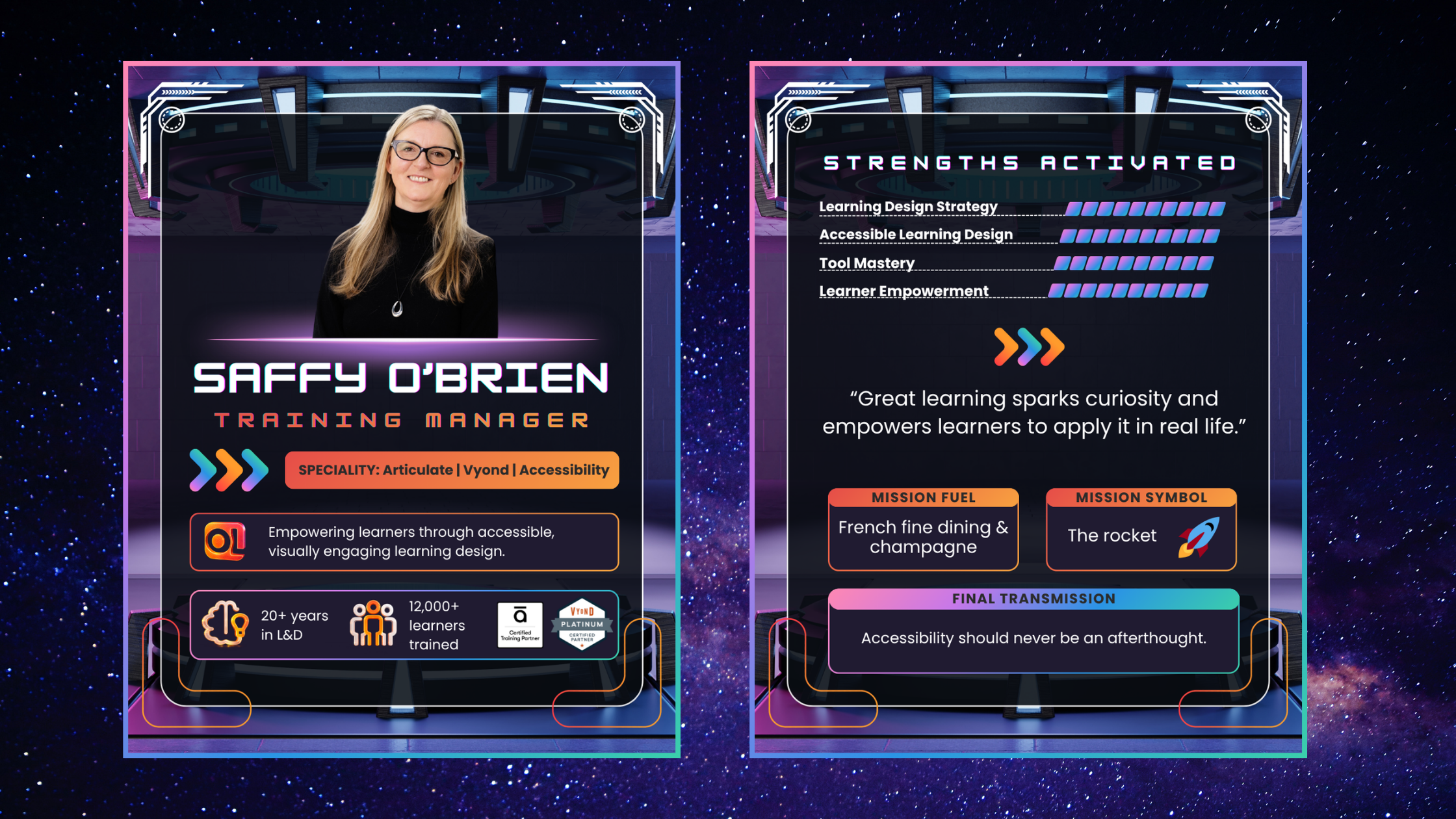
Mission role: Training Manager
Speciality: Articulate | Vyond | Accessibility
Years in the L&D orbit: 20+
What’s mission critical for great learning?
Empowering your learner is essential. How do you do that? You need to make content that creates that spark of curiosity, and it needs to have exceptional visual design. I get so put off by misaligned text!
What learning trend is on your radar right now – and why?
I’m really excited about vibe coding, particularly in Articulate Rise 360, and the endless possibilities it creates for beautifully designed interactive eLearning. I’m not a coder by trade, but I am a self-confessed geek! It allows you to design and create custom branded interactive blocks that are mobile responsive and accessible, so you can delight your learners with the output.
Where should AI act as co-pilot – and where should humans stay in control?
AI is an assistant. It can help you structure thinking and support tasks like writing code when you don’t know how. But emotions and real feelings are human. Coaching is a prime example – AI cannot read body language, understand vulnerability in the room or know when to hold back.
In L&D, humans should always make the final call on learning design and any sensitive topics should always be human-led. We still need face-to-face connection, to laugh and connect as colleagues and friends. That is irreplaceable.
What should learning teams ask before launch?
A conservative answer is making sure that you start with the end in mind – backward design. What will the final course look like? But I challenge all L&D teams to ask at the beginning of every course creation: will this course be accessible to all learners? This is a passion of mine, and it is imperative that accessibility is not considered as an afterthought.
What’s mission critical when time or budget is tight?
You’ve got to look at this logically and strategically: what is need-to-know rather than nice-to-know? It’s important to have quality over quantity.
Foundations come first – then consider an advanced course to highlight other features. The outcome speaks for itself when learners retain the foundations and then build on top, rather than cramming it all in and nothing sticks. Be strategic!
Outside of training missions…
Fuel of choice: French fine dining and champagne!
Favourite space emoji:🚀 – it’s engineered carefully!
The song that’s on repeat in your spacecraft: Glorybox – Portishead
Your spacecraft has room for three things – what makes the cut?: Swim goggles – I can’t live without swimming when we land! Music – I need to be able to sing loudly and out of note (in space no one can hear you sing!). PJs – essential for relaxing.
👉 Explore Articulate 360 accessibility training
Crew ID: Kica
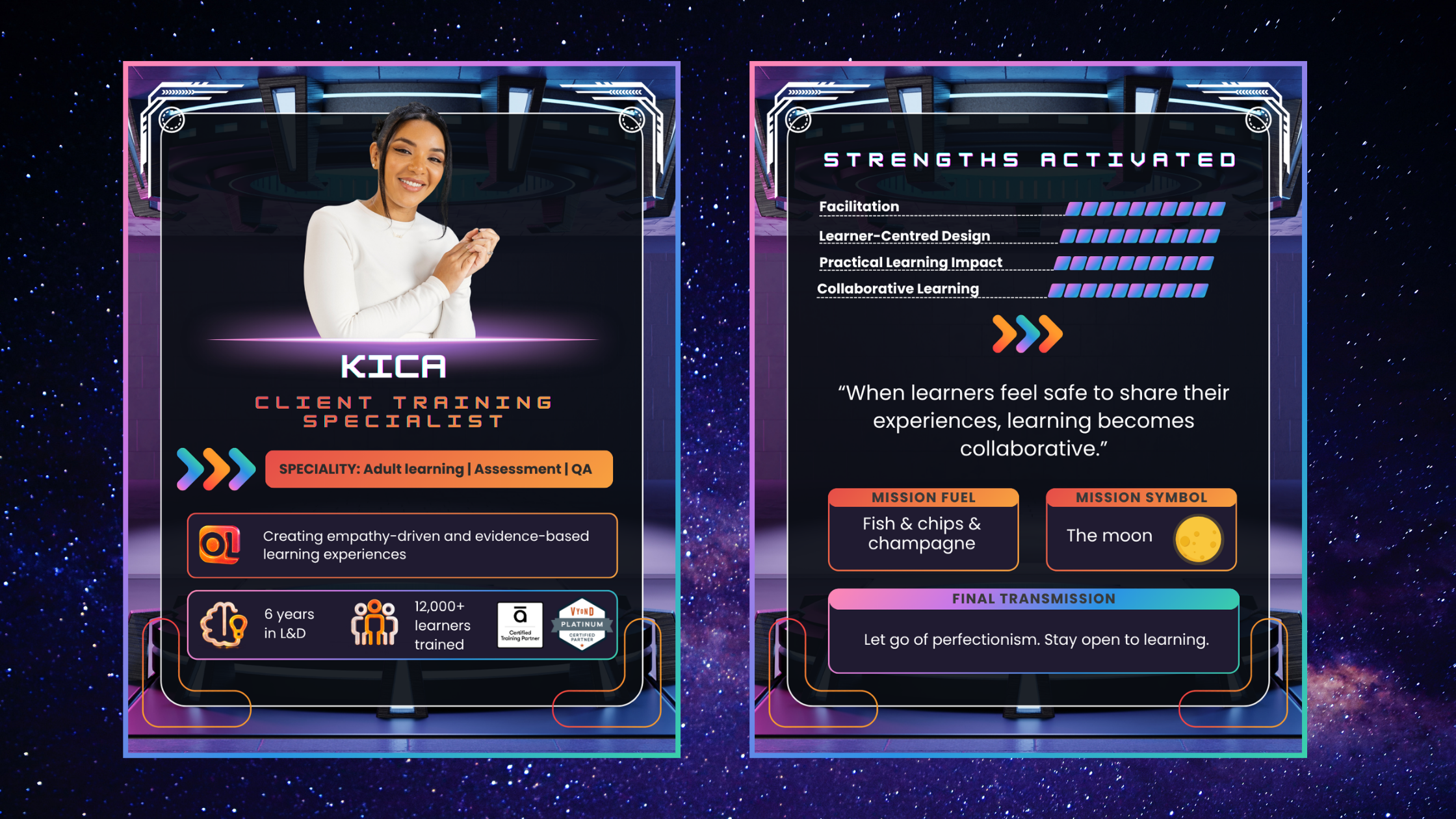
Mission role: Client Training Specialist
Specialism: Adult training | Assessment | Quality assurance
Years in the L&D orbit: 6 years
What’s mission critical for great learning?
Inclusion. When people feel safe and comfortable sharing their lived experience and perspectives, learning becomes a more collaborative process.
What learning trend is on your radar right now – and why?
The growing use of immersive technologies such as VR to support experiential learning, especially in safety-critical or operational environments. Alongside this, there’s an increased focus on accessibility, ethics and sustainability when these technologies are implemented.
How do you create training that leads to real change after lift-off?
By taking a learner-centred approach. This means offering adult learners appropriate autonomy, understanding what matters to them and using a range of learning methods to make content as relevant and inclusive as possible.
What should learning teams ask before launch?
Who are we designing this for – and what do they actually need? Understanding your learners early helps ensure training is beneficial for everyone who will experience it.
If you could travel back in time to your first year in L&D, what advice would you give yourself?
Let go of perfectionism. It’s impossible to create the perfect experience for every learner, but leading with kindness, being open to feedback and staying willing to learn yourself means you’ll always be improving.
Outside of training missions…
Fuel of choice: Fish and chips… and champagne. Ideally not together, but I’m open-minded!
Favourite space emoji: 🌕 According to feedback my training style is welcoming, intuitive and feels safe – a bit like the moon.
The song that’s on repeat in your spacecraft: Anything 80s funk, soul or boogie.
Your spacecraft has room for three things – what makes the cut?: Ear plugs, an eye mask and a huge fluffy blanket to catch up on all the sleep parenting has stolen from me!
👉 Go beyond the basics with Advanced Storyline training
Crew ID: Graham Newey
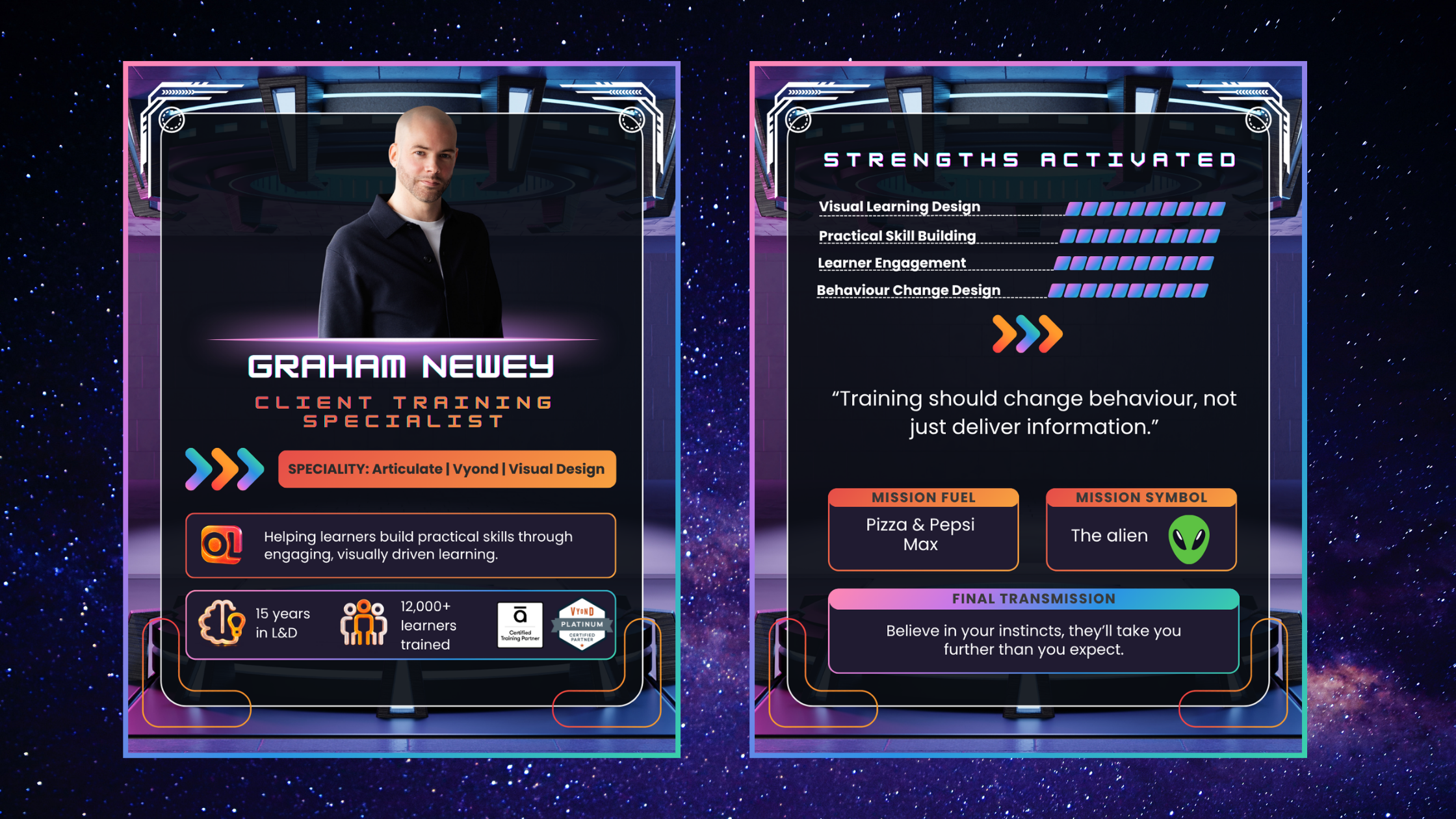
Mission role: Client Training Specialist
Specialisms: Articulate | Vyond | Visual Design
Years in the L&D orbit: 15
What training mission do you love piloting most?
I genuinely enjoy helping people learn regardless of the topic. However, if I had to choose a favourite, it would be graphic design because it lets me combine creativity with problem-solving and visual communication.
What’s mission critical for great learning?
Great learning needs to be relevant to the audience, well-structured and engaging, and as practical as possible. When learners can clearly see the value, stay engaged and apply knowledge hands-on, the learning tends to stick.
How do you create training that leads to real change after lift-off?
Effective training needs to focus on behaviour change rather than simply delivering information. People need to clearly understand the relevance of the change – why it matters and how it impacts their work.
Repetition is also key. Real change rarely happens after a single course or event; it requires reinforcement over time through practice, reminders and continued learning. After all, we are creatures of habit, and meaningful change takes time.
Where should AI act as co-pilot – and where should humans stay in control?
AI can be a powerful assistant when it comes to speeding up work, analysing information or helping us explore ideas. But I believe humans should stay in control when it comes to creativity and decision-making. We still need that human perspective and emotional depth – the “human touch” that makes creative work meaningful.
If you could travel back in time to your first year in L&D, what advice would you give yourself?
I remember feeling incredibly inspired by an induction programme early in my career. It was so well delivered, and you could feel the excitement in the room. People were buzzing to start, and the training played a big part in that. I remember thinking, “I want to be one of those trainers.”
My advice to my younger self would simply be to believe in that instinct. Six months later I became a trainer, and a few years after that I was delivering induction programmes myself, across different countries and organisations. I still cherish that first experience today.
Outside of training missions…
Fuel of choice: I feel like I should say something cool and sophisticated… but in the interest of honesty – and despite the risk of being judged – I’ll go with pizza and Pepsi Max. Simple pleasures.
Favourite space emoji: 👽 I wanted a unicorn 🦄 but I guess it doesn’t go with the theme!
The song that’s on repeat in your spacecraft: Opalite by Taylor Swift
Your spacecraft has room for three things – what makes the cut?: Can I take my iPhone? That would tick a lot of boxes! Then I’d add my camera and a Bluetooth speaker – because even in space I’d still want to take photos and play music at full blast.
Ready to launch your own learning mission? Discover our full range of expert-led training courses.