














 BACK
BACK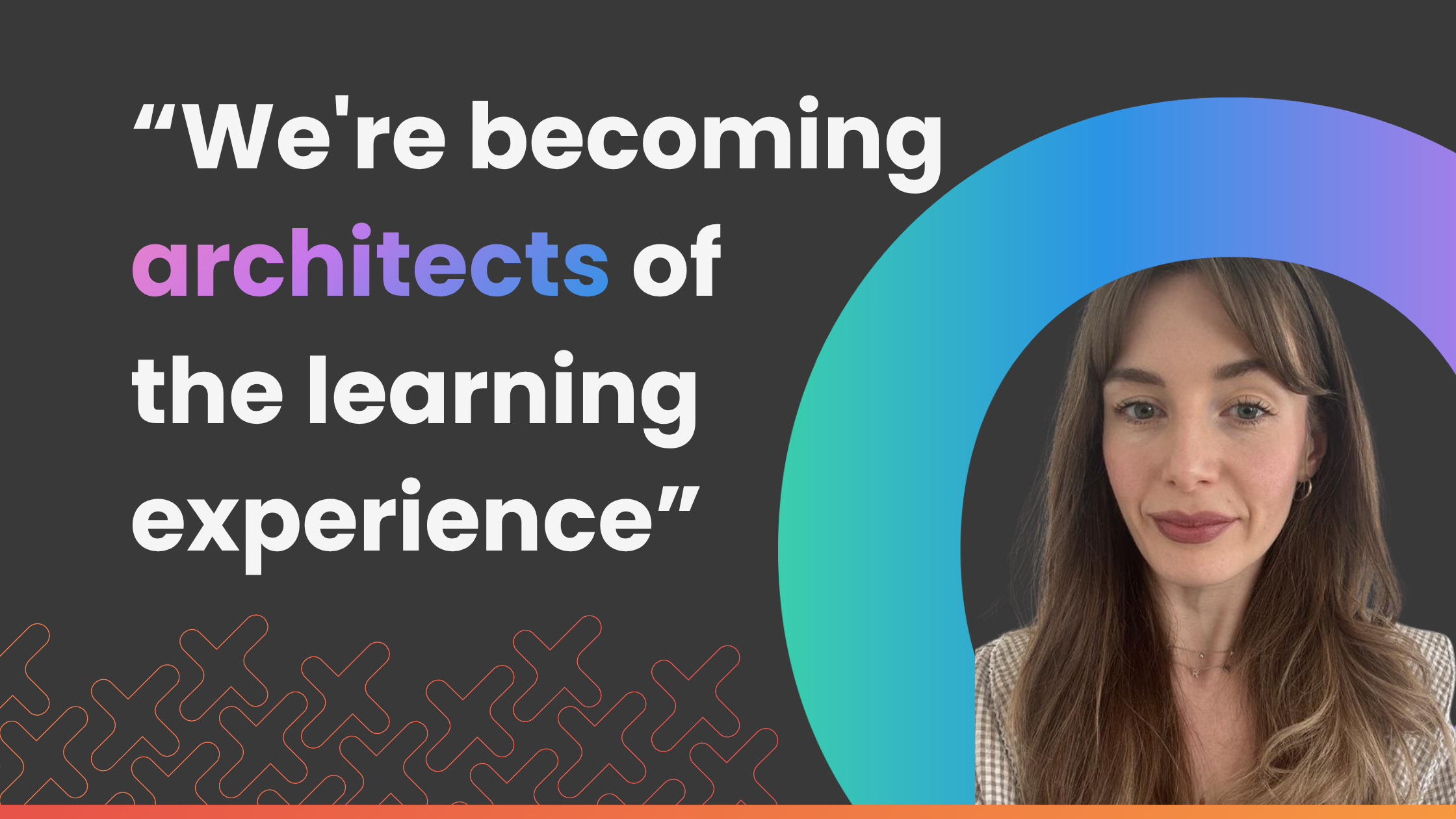
When AI first started entering our workflow, I’ll admit I was quite sceptical. My manager at the time suggested we try it to see what it could do, what it was capable of. My reaction was pretty much: I don’t need help with this. I’ve been doing my job fine this far without it.
Underneath that, there was some worry too. The more we use it, the more we rely on it. That felt like a slippery slope.
Fast forward to today, and I use it a lot more than I expected. But ultimately, it’s just an aid – the expertise, empathy, judgement and strategy still sit with me.
Where AI helps instructional designers the most
When you’re moving at pace, you can’t underestimate what AI brings to L&D in terms of efficiency. Being able to summarise loads of resources, pull out key information and map learner demographics at speed is invaluable. It’s the kind of legwork that used to take up a big chunk of my day.
Our content workshops can run for up to three or four hours. As the person leading the session, you want to be focused on the solution, not frantically taking notes. AI handles that; it frees you up to be present in the room – guiding the session, not logging it.
Another area where AI really helps – and where I’d go as far as saying it’s been life-changing – is structuring content. That’s really the crux of it for instructional designers: you have so many ideas, so much content and so little time that actually getting started is the hardest part. Think of it like essay planning. AI is good at giving you a breakdown, and then you can go off and get straight to the part that matters.
And that’s really the point. AI gives time back – time for the consultancy. To be in the room with the client, to ask better questions and to focus on being the behavioural change expert, rather than the copywriting.
The limits of AI
AI can do a lot. But it can’t do everything – it still needs constant management and curation across the whole process.
The biggest thing it can’t capture is the why behind learning. Instructional designers always have that question in the back of their mind, whatever they’re working on. Even something as simple as a PDF – you’re asking yourself, why a PDF? How does that support the learning journey?
AI doesn’t do that. You ask it for something, and it just goes with it. When AI produces content, it’s not stopping to ask what the learning needs to do, or what behaviour needs to shift and why.
And it never questions you. A colleague will ask, why did you do it that way? Suddenly you’re thinking harder, designing better. AI won’t do that; it’ll just tell you it’s amazing. If you want it to blow smoke, it will. That’s a real worry for emerging designers – you need the experience to push back. To not just trust it because it sounds convincing. To keep asking: how does this link to the learner and to what the client actually needs?
I noticed this first-hand recently. I was using AI as a sounding board when it repeated something from an earlier module. When I flagged that I didn’t want it repeated, it agreed – gave me this whole spiel about why repetition is bad for the brain. But if I’d just been going through the motions? That would have been missed entirely.
What only you can bring
Every instructional designer brings something different to the table. One of my colleagues was a teacher, another came from an agency background. We’ve all got different things to offer – different backgrounds and experiences.
That shapes everything – the instinct for pace, for where learners will struggle, for what really makes something stick. When you get a room full of IDs together, you get a wealth of experience, perspectives and instinct that AI simply can’t replicate.
Ask AI to be an instructional designer and it can only be what you’ve told it to be. It works on patterns. It doesn’t bring lived experience. You can’t set a parameter for the fact that you’ve sat in a hundred client workshops, learned to read a room, or know instinctively when a learner is just going to switch off. That takes human judgement. Years of it.
And then there’s the empathy. We’ve all been learners. We know what it feels like to sit through something that doesn’t respect your time, or to finally have something click. That understanding shapes every design decision – consciously or not. AI can’t put itself in the learner’s shoes. It’s just processing patterns.
What we offer – the ability to step back, challenge, reframe and design for actual behaviour change – comes from experience and expertise, not a well-written prompt.
Architects of the learning experience
The way I see it, AI handles the data, the summaries, the structures, the starting points. What’s left – and what will always be left – is the part that requires a human. The strategic thinking. The relationships. The judgement. Anything client-facing or learner-facing? That stays with the instructional designer.
The role is shifting. We’re becoming more consultants, more architects of the learning experience, rather than content creators. Honestly, it’s an exciting place to be. The skills that make a great instructional designer – empathy, experience and the ability to understand what will meaningfully change behaviour – have never been more valuable. AI just makes it easier to spend your time on them.
So use it. Use it as the aid it is. Just never forget that the thinking is yours.
About the author
Milli Manzano is a Senior Instructional Designer with eight years experience in L&D. She started out coordinating digital learning projects before moving into development and script writing, eventually finding her way into learning design – where her real passion lies.
She specialises in the psychology of learning, and loves applying the science of how the brain takes in and retains information to everything she builds. For Milli, great learning starts with truly understanding your learners – their day, their needs and the time they actually have.
Outside of work, she’s kept busy by two young children, a regular running habit and a growing love of early nights with a good book. She also spent a few years covering London Fashion Week as a fashion journalist – which, as she puts it, felt a lot like living inside The Devil Wears Prada. Safe to say, she’s happy where she landed.
AI is a brilliant aid. But great learning still starts with the right people. Whether that’s finding the right tools like Articulate 360, or working with a team on consultancy or bespoke designs, get in touch to find out how we can help.