Great instructional design rarely gets the credit it deserves. At its best, it’s invisible; learners move from confusion to confidence without ever noticing the thinking behind it, but that ease is the product of real craft.
We sat down with Kica, OL’s Client Training Specialist and the trainer behind our ITOL-accredited Instructional Design Diploma, to get under the surface of what separates great learning from courses that merely get clicked through and forgotten.
From the risks that undermine a good course, to why visual design deserves far more respect than it gets, here’s what she had to say.
What does great instructional design look like in practice?
Instructional design looks quite different depending on the context. It could cover everything from a poster to an hour-long eLearning module to even making an entire three-day trainer-led experience.
But whatever the format, great instructional design should make the path from “I don’t know how to do this” to “I can do this confidently” as straightforward as possible. That means creating a solution that changes behaviour through an experience, rather than just pushing information onto learners. You need to pull them towards the knowledge they need, and think through how they’ll apply it – and later, practise it – in their role.
The best instructional designers are also brilliant storytellers, right from the start of a project. Their learning needs analysis carries a narrative on what the solution needs to achieve: the issue, why it’s a problem, where learners are struggling, and what support already exists around them. From there, they design an experience rooted in that empathy, using a blend of formats, activities, and support that gets learners where they need to be.
What’s a mistake you see again and again that can undermine an otherwise good learning experience?
There are two big mistakes I often see in L&D:
Unknowingly incorrect, outdated, or inappropriate content
This is the biggest one. Sometimes it’s a quality issue, sometimes it’s a blind spot, and increasingly it happens when content is updated using AI without the right QA in place. When you’re designing learning everything needs to be evidence-based and accurate.
That’s why relying on a solo instructional designer is risky. We can’t expect one person to spot every potential issue, especially when designing for learners whose experiences differ from our own.
There’s enough evidence around inclusion and accessibility to know that people don’t always experience learning in the same way. Feedback from multiple perspectives – including the learners you’ve designed for – help us challenge our own assumptions and expose our blind spots.
Underestimating visual design
The other big mistake is underestimating how much visual design impacts engagement. It’s often treated as an afterthought – something that makes courses look nice – but there’s science behind it.
Part of the issue is that visual design and instructional design get lumped together, when they’re two very different skillsets. Some instructional designers do excel in both disciplines, but if visual design isn’t your strength, you can build excellent content and then present it so poorly that the learning point is lost. It’s a valuable skill to build, or bring someone in to help with.
We talk about this a lot on our Instructional Design and Visual Design courses. We look at examples of poor learning design, unpack the psychology behind why it doesn’t work, and talk through what would make it more effective. The consensus is always the same: if a course looks low quality, learners assume the content is too.
👇 Explore the courses
When a piece of learning isn’t having the desired impact, where do you look first?
Annoyingly, there are many different things that can impact whether learning sticks. For example, if it’s an infographic, I might look at the visual design. If it’s a PowerPoint slide, I might analyse if a different format or activity would work better. If it’s something I’m delivering live, it could point to an unsuitable learning environment or a lack of prerequisite knowledge.
The best place to start, however, is with the people it isn’t working for. Go to the learner, and that’ll tell you everything. Gather their feedback – ideally both qualitative and quantitative data – to understand the pain points, before deciding what needs to change.
The only way to know is to ask. We’re often designing for people we don’t know well, and what looks good to us isn’t necessarily what they need.
How do you design learning that changes behaviour, not just completion rates?
Completion data absolutely has its place, particularly when designing compliance or mandatory learning. Sometimes we just need to know that learners have completed or attended a course. But designing for behaviour change goes much deeper than that, and should be the aim of most learning experiences.
Behaviour change always starts with a good needs analysis. You need to ask the right questions to understand:
- The performance problem
- Who you’re designing for
- What they’re doing today
- What they need to do differently
- Why it’s important
- The barriers standing in the way
From there, think scenario-based. Put the learner into realistic situations, get them to make decisions, let them try things out, and give them feedback. You can use role play, eLearning, virtual reality, or business simulations to mimic the environments, decisions, and challenges they’ll encounter in their role. That way, you’re not just telling them what they should know, you’re giving them the opportunity to build the confidence and judgement to use those skills in practice.
If it’s an instructor-led experience, consider how it’s delivered too. Instructional designers don’t always present the training themselves, so think beyond the theory and design to how it’ll be received in the room.
👉 Meet the trainers: the experts behind the learning
If you could change one thing about how organisations approach instructional design, what would it be?
I’d like to see instructional design treated more like a specialist discipline.
There’s often an assumption that because somebody understands the topic, they can automatically design effective learning around it. But a subject matter expert isn’t automatically an instructional designer, and an instructional designer isn’t automatically a strong visual designer.
A lot of organisations treat one instructional designer as the whole toolkit. In our team, we specialise: some of us love systems training and tools, others love the theory and design side. That specialist approach is what creates exceptional learning experiences.
AI has amplified the problem by making it incredibly easy to generate content. It’s quick, and it will give you a course, but it’s not a good experience creator, not in the way humans are.
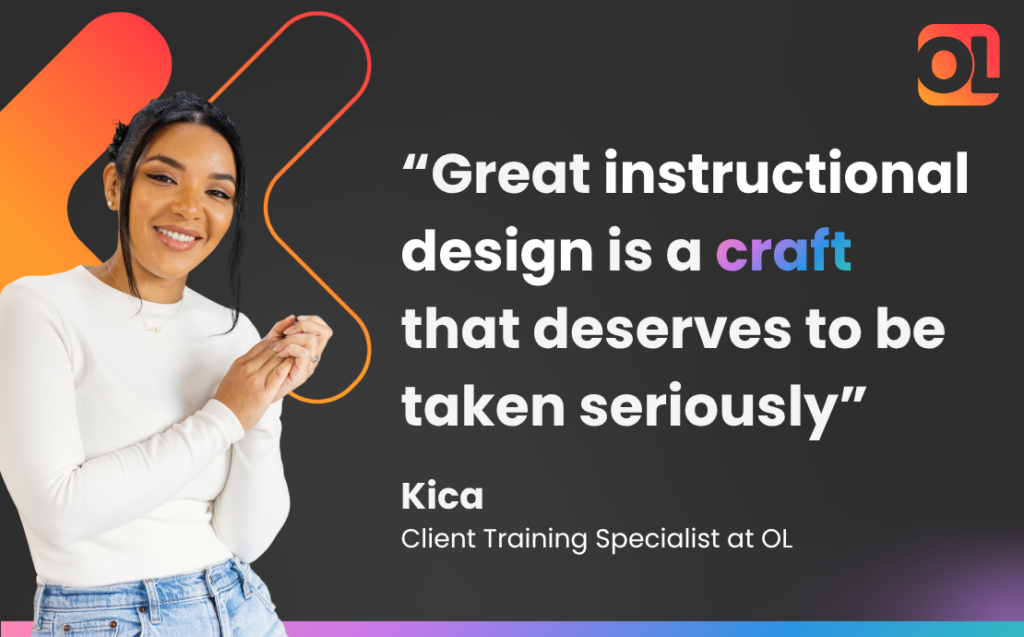
“Great instructional design needs human empathy and a deep understanding of how people learn. It’s a craft, and one that deserves to be taken seriously.”
Kica
👉 Fancy learning the craft yourself? Explore our L&D courses
How has the role of instructional design evolved in 2026?
The biggest shift I’ve seen this year is how comfortable people have become with AI.
At the start of the year, when I delivered courses, I’d see an even split between curiosity and resistance. Now, almost everyone tells me they’re using it. It’s embedded in so much of what we do – even outside of work – that most people have had no choice but to engage with it, even those who were resistant before.
What AI has done though, in my view, is expose where the value of instructional design sits: designing for the human learning experience.
It’s also been interesting to see how much of the thinking in Donald Taylor and Egle Vinauskaite’s Transformation Triangle is starting to show up in L&D. The model explores how L&D can move beyond its traditional focus on creating and delivering content, towards roles centred on skills, enablement, and organisational performance. And you can see this happening; learning is increasingly being tied to organisational goals and expected to demonstrate its value, whatever area of L&D you work in.
About the expert
Kica (Kee-sha) is a Client Training Specialist at Omniplex Learning, with over seven years of experience in L&D. She started her career in further education as a lecturer and assessor, before transitioning into private and commercial aviation training. Over time, she branched into learning design, digital learning, assessment, and quality assurance across sectors as varied as rail, inclusion, beauty, and defence. Having worked across so many industries, Kica brings a well-rounded view of the entire learning lifecycle to her role at OL.
Day-to-day, Kica designs and delivers training courses – including the popular Instructional Design Diploma – support clients outside of the training room, reviews and improves existing content, embeds quality processes, and works with stakeholders to develop private or bespoke training solutions. She holds qualifications in adult learning, assessment, and L&D, and is currently working towards her IQA certification.
Her core focus is on delivering adult learning through a constructivist approach so participants can explore concepts while also applying their own creativity. She describes her facilitation style as approachable and relaxed, though course quality and overall learner experience always come first.
As she works in such a dynamic environment, outside of work, Kica likes to slow things down and stop to smell the roses. She’s often found in the garden, playing with her daughter, doing yoga, or enjoying some much needed rest and relaxation.
Design better courses with OL
Whether you want to master your authoring tools or nail the fundamentals of excellent instructional design, we’ve got a course to match. And if you’re looking for something more bespoke, we also offer tailored training. Get in touch to find out more.