Looking for your next L&D read? We asked our in-house experts to share the books that have shaped how they think about learning, from behaviour change and instructional design to leadership and the future of work.
As the nights draw in, there’s no better time to curl up with a good book. And if brushing up on your L&D knowledge is on your list for the new year, consider this your head start. Whether you’re after practical frameworks, a fresh perspective, or something to challenge your thinking, here are the best L&D books.
Best learning and development books: at a glance
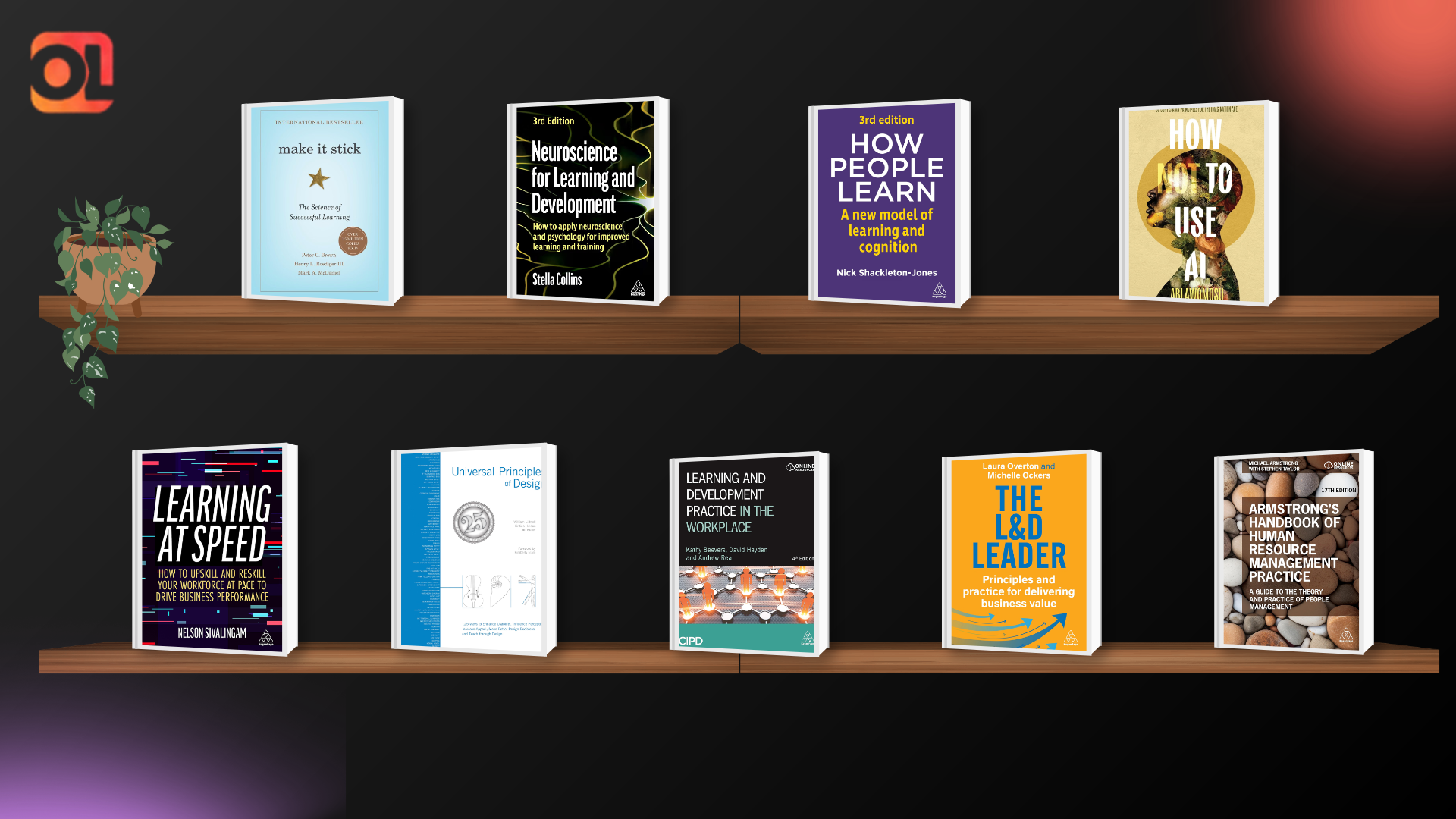
- Neuroscience for Learning and Development, Stella Collins
- Learning at Speed, Nelson Sivalingam
- Universal Principles of Design, William Lidwell, Kritina Holden and Jill Butler
- How Not to Use AI, Abi Awomosu
- The L&D Leader, Laura Overton and Michelle Ockers
- How People Learn, Nick Shackleton-Jones
- Learning and Development Practice in the Workplace, Kathy Beevers, Andrew Rea and David Hayden
- Armstrong’s Handbook of Human Resource Management Practice, Michael Armstrong and Stephen Taylor
- Make It Stick, Peter C. Brown, Henry L. Roediger III, and Mark A. McDaniel
👉 More from OL: How to conduct a learning needs analysis
Neuroscience for Learning and Development by Stella Collins
Recommended by: Milli Manzano, Senior Instructional Designer
The first time I heard Stella Collins speak about learning psychology, I was hooked. Her insights made me reflect on my own approach to learning design and how I could better incorporate evidence-based principles into my work.
What I love about this book is how clearly it explains the science of learning. Stella makes complex ideas easy to understand without oversimplifying them, and each section provides practical takeaways that you can immediately put into practice.
It remains my favourite L&D book, and I find myself applying its principles almost every day in my design! If you’re interested in creating learning that truly works, this is an invaluable read.
👉 More from Milli: AI is the assistant. You’re still the instructional designer
Learning at Speed by Nelson Sivalingam
Recommended by: Leena Randhawa, Director of Learning and Community
This is a really practical, straight-talking read for anyone in L&D who feels like they’re constantly playing catch-up with the business.
Nelson makes the case for agile learning design, and he does it in a way that actually makes sense. The core argument is that the way most L&D teams work – long development cycles, big courses, slow sign-off processes – just doesn’t fit the pace organisations are moving at now. And honestly, it’s hard to disagree.
What I love about it is that it doesn’t just diagnose the problem, it gives you a framework and practical tools to do something about it. It’s the kind of book you read and immediately want to apply. If you’re trying to build an L&D function that’s faster, more targeted, and genuinely aligned to what the business needs right now, this is a great place to start.
👉 More from Leena: L&D was never meant to be a production line
Universal Principles of Design by William Lidwell, Kritina Holden, and Jill Butler
Recommended by: Graham Newey, Client Training Specialist
I believe that a great contributing factor in a good digital training experience is visual design. Universal Principles of Design is one of the most useful books I’ve come across because it explains the psychology and principles behind effective visual communication, rather than focusing on specific software or design trends.
The book covers 200 design principles in a clear, accessible way, helping learning designers make more informed decisions about layout, hierarchy, attention, memory, accessibility, and learner engagement.
👉 More from Graham: Meet the trainers: the experts behind the learning
How Not to Use AI, by Abi Awomosu
Recommended by: Tracey Kench, Content Development and Product Discovery Manager
This is a fantastic book for those of us who want to ensure we are getting the best out of AI but at the same time want to keep our own curiosity, ideas, and creativity skills intact. Abi talks about how to challenge AI and to really think before blind-prompting, and how to reduce the AI slop but increase the depth of knowledge that can be pulled from within the engine.
I’d highly recommend it, but beware – this book will change the way you think and the way you look at the world of AI!
The L&D Leader by Laura Overton and Michelle Ockers
Recommended by: Leena Randhawa, Director of Learning and Community
Laura Overton is someone I have a huge amount of respect for, so when she co-wrote The L&D Leader with Michelle Ockers, it went straight to the top of my list.
It’s a strategic read aimed at L&D leaders who want to make sure their learning strategy is delivering value to the business, not just activity. Laura has spent decades researching what makes L&D work, talking to thousands of professionals, and that depth of insight really shows. It’s not theoretical, it’s grounded in what really happens in organisations.
The big themes are ones I think about all the time: aligning L&D to business priorities, building capability for future needs, and moving from being output-focused to outcomes-led. It also tackles the culture and change side of things, which doesn’t get enough airtime in our world.
If you’re in a senior L&D role and you’re trying to build something that lasts, earns credibility, and can evidence its impact, this is well worth your time.
👉 Related reading: How to grow your people with a leadership development strategy
How People Learn by Nick Shackleton-Jones
Recommended by: Kevin Gale, Head of Learning Experience, and Kica (Kee-sha), Client Training Specialist
Kevin: I’d recommend How People Learn by Nick Shackleton-Jones because it challenges traditional learning approaches and offers a practical, human-centred way to design learning around what people genuinely care about and need.
Kica: It completely shifts the focus from traditional “information dumping” to designing meaningful learning experiences and resources. It aligns with my own belief that learning shouldn’t be “tell, tell, tell”, it should challenge people’s thinking, respect their time, and focus on what is going to help them perform well.
👉 More from Kica: The best instructional designers are brilliant storytellers
Learning and Development Practice in the Workplace, by Kathy Beevers, Andrew Rea, and David Hayden
Recommended by: Lucy Heath, Community Manager
My two picks are the books behind my CIPD Level 5: Learning and Development Practice in the Workplace by Kathy Beevers, David Hayden, and Andrew Rea, and Armstrong’s Handbook of Human Resource Management Practice by Michael Armstrong and Stephen Taylor (more on that below).
I’ve lost count of how many times I went back to them. Beevers, Hayden, and Rea are my go-to for anything L&D. The book is practical and easy to dip into, and it covers everything from spotting learning needs through to designing, delivering, and evaluating. The sections on informal learning and digital delivery were really useful because they backed up what I do day to day with tools like Articulate and Vyond.
Armstrong’s Handbook of Human Resource Management Practice by Michael Armstrong and Stephen Taylor
Recommended by: Lucy Heath, Community Manager
Armstrong and Taylor give me the bigger picture when it comes to learning: what being a people professional actually means, and how L&D and HR feed into how a business performs. Between this and Learning and Development Practice in the Workplace, you get both the “how” and the “why”, so I’d recommend them to anyone in L&D or people practice, studying or not.
👉 Read next: How to set professional development goals
Making It Stick by Peter C. Brown, Henry L. Roediger III, and Mark A. McDaniel
Recommended by: Leena Randhawa, Director of Learning and Community
This is one of those books that I hear people say has changed how they think about learning design.
Making It Stick is written by cognitive scientists, but don’t let that put you off. It’s one of the most readable books I’ve come across on the subject. It draws on decades of research into how people learn and retain information, and a lot of it will challenge things you’ve probably taken for granted.
The big insight is that the strategies most people use when learning – re-reading notes, highlighting, cramming – feel productive but aren’t. The techniques that really work, things like retrieval practice, spaced repetition, and interleaving, feel harder and less satisfying, which is exactly why we avoid them.
For L&D professionals, it’s a brilliant reminder that how we design learning matters just as much as what we put in it. If you’ve ever built something that looked great but didn’t seem to stick, this book will probably tell you why.
👉 More from OL: How to build an upskilling strategy
Turn great ideas into learning that sticks
The best books for learning and development professionals can spark great thinking, but their true value comes from putting those ideas into practice. That’s where OL can help.